At the turn of the century, New York was the preeminent American city; it represented the "new metropolis." The great waves of European immigrants coming to New York, the consolidation of the five boroughs into one vast city, the development of the city's infrastructure, and the incredible construction boom of the next thirty years all contributed to the city's prominence. In many of the New York films there is a sense of pride, or perhaps a celebration of the emergence of the great metropolis.
At the turn of the century, New York was the preeminent American city; it represented the "new metropolis." The great waves of European immigrants coming to New York, the consolidation of the five boroughs into one vast city, the development of the city's infrastructure, and the incredible construction boom of the next thirty years all contributed to the city's prominence. In many of the New York films there is a sense of pride, or perhaps a celebration of the emergence of the great metropolis. The best of these films convey the sense that the already sprawling city was in the process of becoming something much more than a squalid, chaotic urban center; there are skyscrapers going up -- the tallest in the world; a great suspension bridge being opened -- the largest in the world; and a new subway system -- the longest in the world. We see a proud police force marching in front of a large crowd, orderly columns of street sweepers parading in clean white suits, and the most powerful fireboat in the world blasting jets of water from all of its nozzles simultaneously.
Below you will find some sample clips from four of the films on this CD.
|
|
Below you will find a description of each film on this CD
|
Arrival of emigrants [i.e. immigrants], Ellis Island CREATED/PUBLISHED United States : American Mutoscope and Biograph Company, 1906. SUMMARY Depicts scenes at the Immigration Depot and a nearby dock on Ellis Island. Appears to show, first, a group of immigrants lined up to board a vessel leaving the island, then another group arriving at the island and being directed off of the dock and into the Depot by a uniformed official. |
|
At the foot of the Flatiron CREATED/PUBLISHED United States : American Mutoscope and Biograph Company, 1903. SUMMARY This street level view is of the Broadway side of the Flatiron, or Fuller Building, near the narrow north corner. Filmed on a very windy day, pedestrians of various descriptions are seen passing by the camera, clutching hats and skirts against the wind. According to some New York City historians, this corner was known as the windiest corner of the city, and in the era of the long skirt, standing on it was considered a good vantage point for a glimpse of a lady's ankle. Policemen would chase away such loungers from the 23rd Street corner, giving rise to the expression "twenty-three skidoo." |
|
Automobile parade CREATED/PUBLISHED United States : Thomas A. Edison, Inc., 1900. SUMMARY This may be the first annual automobile parade, held on November 4, 1899 in downtown Manhattan. At least ten different makes and models are seen, including electric and steam powered machines. Only three years earlier, in 1896, Henry Ford, Charles Brady King, Alexander Winton and Ransom Eli Olds had each introduced their gasoline cars. In 1900, the first National Auto Show was held at Madison Square Garden and the favorites were the electrics and the steamers. In 1901, new oil fields in Texas made gasoline affordable. That same year, mass production techniques were introduced into car manufacturing. These two factors would prove to be key developments in the rapid growth of the American automobile industry. |
|
Bargain day, 14th Street, New York CREATED/PUBLISHED United States : American Mutoscope and Biograph Company, 1905. SUMMARY The film shows hundreds of tightly packed people crowding into the front door of the Rothschild Co. 5 and 10 cent store. They are so closely packed it is difficult to tell one from another. The view is from across the street, looking down from the 2nd floor. |
|
Beginning of a skyscraper CREATED/PUBLISHED United States : American Mutoscope and Biograph Company, 1902. SUMMARY The scene is an excavation site in New York City. A large group of workmen with picks and shovels are digging. Carts drawn by pairs of horses can be seen emerging from the smoke in the background. |
|
Broadway & Union Square, New York CREATED/PUBLISHED United States : American Mutoscope and Biograph Company, 1903. SUMMARY This short film shows two horse-drawn streetcars, one approaching the camera and the other heading away. Passengers can be seen boarding and getting off of the crowded cars. |
|
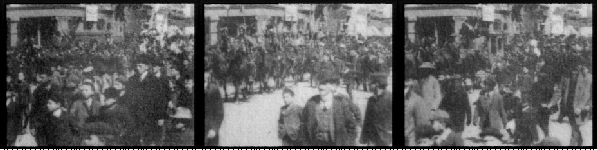
Buffalo Bill's wild west parade CREATED/PUBLISHED United States : American Mutoscope and Biograph Company, 1902. SUMMARY The film shows a parade down Fifth Avenue, New York. In the foreground many children, both black and white, can be seen following alongside the parade. The participants in the parade include cowboys, Indians, and soldiers in the uniform of the United States Cavalry on horseback and riding horse-drawn coaches. Buffalo Bill can be seen on horseback, lifting his hat to the crowd |
|
Delivering newspapers CREATED/PUBLISHED United States : American Mutoscope and Biograph Company, 1903. SUMMARY The film shows a group of about fifty preadolescent boys running and crowding around a one-horse paneled newspaper van that pulls up in the foreground of the picture. On the side of the van is a sign reading "New York World." As they gather around the rear of the vehicle, a fight breaks out between two of the boys. The film ends as the crowd forms around the two fighters. Probably filmed at Union Square. |
|
Departure of Peary [and the] "Roosevelt" from New York CREATED/PUBLISHED United States : American Mutoscope and Biograph Company, 1905. SUMMARY The camera pans to show the schooner "Roosevelt" docked at a covered pier on the Hudson River on Manhattan's west side. Then, from a camera position on board, men in straw hats and fashionably dressed ladies are seen boarding the ship. Next, the famous polar explorer Robert Peary appears on the gangway in a dark jacket, mustache and straw hat [Frame: 4552]. He tips his hat, consults his watch, then, just before the film ends, motions to order the departure. On this expedition he achieved the "farthest north" record, but failed to reach the North Pole. Completed only four months prior to this film, the "Roosevelt" was specially designed to withstand Arctic ice. She was 184 feet long, 35 and a half feet wide, with a hull over two and a half feet thick. Fully loaded the ship weighed 1,500 tons while drawing only 16.2 feet. In addition to sail power, the ship was driven by a 1000 horsepower steam engine, which could produce short bursts of even greater power to get the ship through thick ice. The "Roosevelt" served Peary on this expedition as well as the following one in 1908-1909. Sold numerous times to a variety of commercial concerns, the "Roosevelt" was abandoned to the elements on a mud flat in Cristobal, Panama in 1937, where she eventually rotted away. |
|
Elevated railroad, New York CREATED/PUBLISHED United States : American Mutoscope and Biograph Company, 1903. SUMMARY The film was photographed from the front platform of a train traveling over elevated tracks in New York City. Although many of the buildings alongside the tracks can be seen, it is difficult to determine the exact location of the scene. |
|
Emigrants [i.e. immigrants] landing at Ellis Island CREATED/PUBLISHED United States : Thomas A. Edison, Inc., 1903. SUMMARY The film opens with a view of the steam ferryboat "William Myers," laden with passengers, approaching a dock at the Ellis Island Immigration Station. The vessel is docked, the gangway |
|
Excavating for a New York foundation CREATED/PUBLISHED United States : American Mutoscope and Biograph Company, 1903. SUMMARY The scene is an excavation pit at an unidentified New York City construction site. A crew of six men can be seen shoveling dirt into a four-wheeled wooden cart. Then a full cart is slowly lifted out of the pit to street level by a steam-powered crane. These carts are similar in design to those shown dumping rubble at the end of the film New York City Dumping Wharf. Advertisements and campaign posters can be seen on the exposed wall of the building in the background. |
|
Fireboat "New Yorker" in action--excerpts CREATED/PUBLISHED United States : Thomas A. Edison, Inc., 1903. SUMMARY This excerpt shows a demonstration by the famous fireboat "New Yorker." The picture shows the fireboat with all its nozzles spurting water as it goes back and forth in front of the camera. Put in service on February 1, 1891 as Engine Company 57, the "New Yorker" was stationed at the Battery near Castle Garden, where her crew lived aboard. She was 125 feet long, 25 feet abeam, with a tonnage of 243. The 800 horsepower triple expansion engine turned a single screw. With a total capacity of 13,000 gallons per minute from its Clapp & Jones and La France fire pumps, the "New Yorker" was the most powerful fireboat in the world. When Admiral Dewey came to New York with the flagship "Olympia" after the battle of Manilla Bay, the "New Yorker" led the water parade of hundreds of craft. Built at a cost of $98,250, the "New Yorker" remained in service until 1931. |
|
Funeral of Hiram Cronk CREATED/PUBLISHED United States : American Mutoscope and Biograph Company, 1905. SUMMARY The film shows a city thoroughfare lined with crowds of people watching a military parade. The first group to come into view is a marching band [Frame: 0120], then a large formation of soldiers in the uniform of Rough Riders [0720]. Following them is a hearse drawn by four black horses, escorted by veterans of the Civil War [2742], and horse-drawn open carriages. The camera position shifts and most of the paraders can be seen for a second time: the band [3692], the hearse [5610], and the Civil War veterans [6000]. Hiram Cronk, a veteran of the War of 1812, died at the age of 105. He was thought to be the last surviving veteran of that war. |
|
Interior N.Y. subway, 14th St. to 42nd St. (in two parts) CREATED/PUBLISHED United States : American Mutoscope and Biograph Company, 1905. SUMMARY The camera platform was on the front of a New York subway train following another train on the same track. Lighting is provided by a specially constructed work car on a parallel track. At the time of filming, the subway was only seven months old, having opened on October 27, 1904. The ride begins at 14th Street (Union Square) following the route of today's east side IRT, and ends at the old Grand Central Station, built by Cornelius Vanderbuilt in 1869. The Grand Central Station in use today was not completed until 1913. |
|
Lower Broadway CREATED/PUBLISHED United States : American Mutoscope and Biograph Company, 1903. SUMMARY The film shows a view which appears to be looking north on Broadway at the intersection of either Wall Street, in front of Trinity Church, or Vesey Street at St. Paul's Chapel. The sidewalk along Broadway is crowded with people, and the traffic in both streets is very heavy. A horse-drawn streetcar passes in front of the camera [Frame: 2814], with a sign giving its destination as the "Courtland and Fulton Street Ferry." |
|
Move on CREATED/PUBLISHED United States : Thomas A. Edison, Inc. 1903. SUMMARY Filmed in New York's Lower East Side, the scene is a street where several pushcart vendors have gathered to sell their goods. In the foreground are fruit and vegetable carts. An elevated railroad track crosses over the street in the background. As the film progresses, two policemen can be seen heading up the street toward the camera and ordering all of the vendors to move. One of the policemen approaches the camera waving his nightstick, and the cart in the foreground begins moving. The film ends with a closeup of the policeman scolding the vendor. |
|
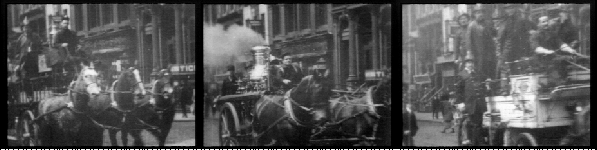
N.Y. Fire Department returning CREATED/PUBLISHED United States : American Mutoscope and Biograph Company, 1903. SUMMARY Shot at an unidentified location in New York City, the film shows several pieces of horse-drawn fire vehicles in motion: two hook-and-ladders [Frame: 0114, 0905]; two steam pumpers [0373, 1111]; a rescue wagon [0549]. Note the kids hanging on the back of some of the vehicles [0195, 0970]. |
|
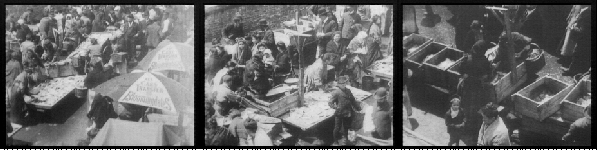
New York City "ghetto" fish market CREATED/PUBLISHED United States : Thomas A. Edison, Inc. 1903. SUMMARY The view, photographed from an elevated camera position, looks down on a very crowded New York City street market. Rows of pushcarts and street vendors' vehicles can be seen. The precise location is difficult to ascertain, but it is certainly on the Lower East Side, probably on or near Hester Street, which at the turn of the century was the center of commerce for New York's Jewish ghetto. Located south of Houston Street and east of the Bowery, the ghetto population was predominantly Russian, but included immigrants from Austria, Germany, Rumania and Turkey. According to a description in a 1901 newspaper, an estimated 1,500 pushcart peddlers were licensed to sell wares (primarily fish) in the vicinity of Hester Street. At one point the film seems to follow three official looking men (one in a uniform) as they walk among the crowd. They may be New York City health inspectors, who apparently monitored the fish vendors closely. |
|
New York City dumping wharf CREATED/PUBLISHED United States : Thomas A. Edison, Inc., 1903. SUMMARY The film shows a wharf where a barge is being loaded with trash from two-wheeled, horse-drawn wagons. The trash is dumped off the edge of the pier onto the barge, where men with shovels are spreading the piles of debris. The camera pans left to the next barge, where four-wheeled carts are shown dumping excavation rubble. Probably filmed on the East River, this is one of several New York City Sanitation Department dumping wharves in operation at the time. |
|
New York Harbor Police boat Patrol capturing pirates CREATED/PUBLISHED United States : Thomas A. Edison, Inc., 1903. SUMMARY This was probably filmed in the southern part of the Upper New York Bay looking towards the Narrows, with Fort Lafayette partly visible in the far background. The subject is a simulated capture by the police gunboat "Patrol" of three "pirates" in a rowboat. Puffs of smoke appear as the gunboat fires several rounds from the bow cannon, which can be clearly seen later in a side view of the boat [Frame: 3642]. The "Patrol" was a steel, twin screw, 135 foot, 118 ton police boat, built in 1893 at Sparrow's Point, Maryland. |
|
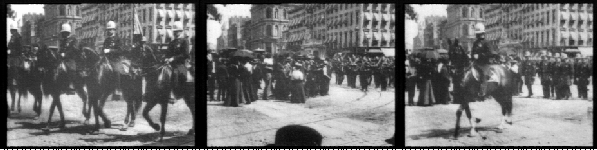
New York police parade, June 1st, 1899 CREATED/PUBLISHED United States : Thomas A. Edison, Inc., 1899. SUMMARY The film shows members of "New York's Finest" parading at a crowded Union Square. There are members of the Bicycle Squad [Frame: 0396], mounted horses [0612], and two regimental marching bands [2518, 3456]. At the time of filming, the New York City Police Department was still recovering from the corruption scandals of the early 1890's that had severely tarnished the reputation of the department. A State Senate appointed group known as the Lexow Committee investigated the department and issued a scathing report that detailed serious criminal activity within the department. In 1895, public opinion was so low that the annual parade wasn't held. That same year, Theodore Roosevelt was appointed president of the Police Board, and he is credited with initiating strict and effective reform measures that helped restore the public's confidence in the police. |
|
Opening of new East River bridge, New York CREATED/PUBLISHED United States : Thomas A. Edison, Inc., 1903. SUMMARY The first view is from the roadway of the Williamsburg Bridge on the day of the opening. Close-ups of the parading dignitaries and members of the press [Frame: 0345] are seen. From another camera position, taken over the heads of the crowd, buildings around the waterfront are seen, and the dignitaries, led by a standard bearer again pass the camera. The banner reads "MAYOR." Next, a covered platform, draped in flag bunting is shown, where the people previously seen have gone to begin the ceremonies. There is a brass band playing in front of the platform [4910]. Next, an unidentified speaker, probably Mayor Seth Low, can be seen addressing the crowd. |
|
Opening the Williamsburg Bridge CREATED/PUBLISHED United States : American Mutoscope and Biograph Company 1904. SUMMARY The film was shot on the roadway of the newly constructed Williamsburg Bridge. The first people to come into view are press photographers carrying large wooden "box" cameras [Frame: 0690]. Next, a parade of dignitaries and military representatives, accompanied by members of the press [1310], is photographed passing the camera position led by a standard bearer whose banner reads "MAYOR" [0902]. The mayor of New York was Seth Low, a lame-duck at the time of filming, having been defeated in November, 1903 by George B. McClellan. The Williamsburg Bridge, a combined cantilever and suspension bridge, crosses the East River from Delancey and Clinton Streets, Manhattan, to Roebling and S. 5th Streets, Williamsburg. Built at a cost of twelve million dollars, it held two lanes of roadway, two "L" tracks, four trolley tracks, and two promenades. It was the largest suspension bridge in the world at the time. |
Here are the computer requirements to run and operate this CD. You must have a PC running Windows or a Macintosh running OS X or higher software and a web browser.