At the turn of the century, New York was the preeminent American city; it represented the "new metropolis." These films convey the sense that the already sprawling city was in the process of becoming something much more than a squalid, chaotic urban center; there are skyscrapers going up -- the tallest in the world; a great suspension bridge being opened -- the largest in the world; and a new subway system -- the longest in the world. We see a proud police force marching in front of a large crowd, orderly columns of street sweepers parading in clean white suits, and the most powerful fireboat in the world blasting jets of water from all of its nozzles simultaneously.
At the turn of the century, New York was the preeminent American city; it represented the "new metropolis." The great waves of European immigrants coming to New York, the consolidation of the five boroughs into one vast city, the development of the city's infrastructure, and the incredible construction boom of the next thirty years all contributed to the city's prominence. In many of the New York films there is a sense of pride, or perhaps a celebration of the emergence of the great metropolis. The best of these films convey the sense that the already sprawling city was in the process of becoming something much more than a squalid, chaotic urban center; there are skyscrapers going up -- the tallest in the world; a great suspension bridge being opened -- the largest in the world; and a new subway system -- the longest in the world. We see a proud police force marching in front of a large crowd, orderly columns of street sweepers parading in clean white suits, and the most powerful fireboat in the world blasting jets of water from all of its nozzles simultaneously.
Below you will find some sample clips from four of the films on this CD.
    |
Below you will find a description of each film on this CD
|
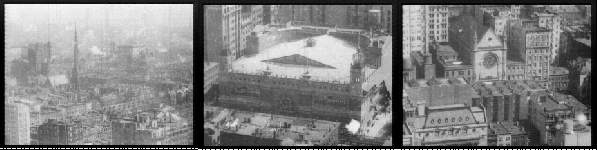
Panorama from the tower of Brooklyn Bridge CREATED/PUBLISHED United States : American Mutoscope and Biograph Company 1903. SUMMARY The view was taken from the tower on the Brooklyn side of the bridge. As the film begins, the camera is looking southwest, towards the southern tip of Manhattan (the Battery). The camera pans very rapidly north following Manhattan's East River shoreline, across the bridge span itself and the bridge's New York side tower, following the shoreline further north towards Corlear's Hook, where the film ends. Some visible landmarks include the Fulton Fish Market buildings at Fulton and South Streets [Frame: 0420] (currently the site of the South Street Seaport Museum); north of the bridge tower is the Catherine Slip, where a Catherine Street Ferry is docked [0568]. |
|
Panorama from Times Building, New York CREATED/PUBLISHED United States : American Mutoscope and Biograph Company, 1905. SUMMARY The view is from the top of the then newly-erected Times Building, at a height of approximately twenty stories. The film opens with a vertical pan, going from the street below up to the sky. The photographer then makes a pan to the north over the tops of the buildings from Bryant Park, south of 42nd Street (behind the New York Public Library) [Frame: 1078] up 6th Avenue to the Hippodrome Theatre at 43rd Street [1866]. A marquee on the theater reads "A Yankee Circus On Mars." The camera continues to rotate toward 44th and 45th Streets between 6th and 7th Avenues, until coming to rest looking directly north up Times Square to 46th Street, where Broadway (left) and 7th Avenue (right) diverge again [3676]. |
|
Panorama of Blackwell's Island, N.Y. CREATED/PUBLISHED United States : Thomas A. Edison, Inc., 1903. SUMMARY This film was photographed from a boat heading south along the eastern shore of Blackwell's Island (known today as Roosevelt Island). The island lies in the East River, between Manhattan (which can be seen in the background) and Long Island City, Queens. It is approximately one and three-quarters of a mile long, extending from 51st Street to 88th, and at the time of the filming was the location for a number of New York City's charitable and penal institutions. The film opens showing the lighthouse at the north end of the island (Hallet's Cove) [Frame: 0186]. As the boat enters the east channel of the river, the stacks of a large brewery on Manhattan are visible in the distance [0542]. The camera pans along the island's granite seawall (built by inmates of the Penitentiary and Workhouse) and the following buildings, in order of appearance, are shown: the New York City Lunatic Asylum [0956]; the Workhouse [1274]; the Almshouse [1524]; piers for the Queensborough (or 59th Street) Bridge, which upon completion in 1908 will span 135 feet above the island [2388]; the Almshouse Keeper's House (originally the home of the Blackwell family, who had once owned the island) [2730]; the Penitentiary [3646]; Charity Hospital [4140]. The film ends before reaching the southern tip of the island. |
|
Panorama of Flatiron Building CREATED/PUBLISHED United States : American Mutoscope and Biograph Company, 1903. SUMMARY This shows a view looking south from Madison Square, across the intersection of Broadway, Fifth Avenue, and Twenty-third Street, to the famous Fuller (or "Flatiron") Building. The cameraman elevates his camera, going from street level to the roof. Designed by D.H. Burnham and Company, the Fuller Building is an important early skyscraper and a New York City landmark. Known as the first great steel-framed building, the exterior of the lower three stories is stone, with the remainder clad in terra cotta. Twenty-one stories high, it is considered the first tall building erected north of city hall. Its completion in 1902 marked the beginning of New York City's first skyscraper era. |
|
Panorama of Riker's Island, N.Y. CREATED/PUBLISHED United States : Thomas A. Edison, Inc., 1903. SUMMARY The film was photographed from a boat going around Riker's Island. Located on the East River north of Hell Gate between the Bronx and Queens, Riker's Island was the site of a massive New York City landfill operation at the time of the filming (originally eighty-seven acres, by 1939 the size of the island had increased to four hundred acres). The film includes scenes of heavy equipment at work, including pile drivers constructing the seawall and steam shovels unloading rubbish from barges. On one of the steam shovels, a sign reading "Water Front Improvement Co., 220 Broadway, New York" can be distinguished [Frame: 3502]. Near the end of the film, a narrow-gauge steam engine with five open cars loaded with landfill, comes into view [3826]. The island is currently the site of a New York City penitentiary. |
|
Panorama water front and Brooklyn Bridge from East River CREATED/PUBLISHED United States : Thomas A. Edison, Inc., 1903. SUMMARY This film depicts the East River shoreline and the piers of lower Manhattan starting at about Pier 5 (the New York Central Pier) opposite Broad Street, and extending to the Mallory Line steamship piers just south of Fulton Street and the Brooklyn Bridge. The film begins with shots of canal boats or barges (from the Erie Canal via the Hudson River) docked at and around Coenties Slip [Frame: 0106]. As the film progresses, the New York Produce Exchange located at Bowling Green, Manhattan, with its distinct tower, comes into view in the background [0346]. Between here and the Wall Street ferry, there follows in order of appearance: steam tugs [0308 and 0422], a wooden hull barkentine [1032] with box barges alongside, a docked iron hull sailing ship, probably British [1448], an ocean steamer with yards on the foremast [1748], a derrick lighter laden with barrels docked at the end of a pier [2134], and a fruit steamer [2612]. In the Wall Street Ferry slip (between Piers 15 and 16) there is a Wall St., Manhattan-to-Montague St., Brooklyn, double-ended steam commuter boat [2896]. The ferry is visible immediately before a shot of the large advertising billboards on Pier 16. The film next shows the Ward Line piers (J.E. Ward & Co., New York and Cuba Steamship Co.) [3040], a Pennsylvania Railroad tug [3190], a derrick lighter [3320], and the Mallory Line piers [3692]. A Mallory Line steamer can be seen on the south side of one of the Mallory Piers [3736]. The camera begins panning out into the East River after passing pier 20, catching the fog bell at the end of pier 21 [3922]. A car float is visible passing under the Brooklyn Bridge [4202]. The pan follows the line of the Brooklyn Bridge eastward to Brooklyn Heights, where the Hotel Margaret (tall building in background) is visible just before the end of the film [4464]. This film continues the view begun in the film Sky Scrapers of New York City From the North River. Together they comprise a sweep around the southern tip of Manhattan, from Fulton Street on the Hudson to the Brooklyn Bridge. |
|
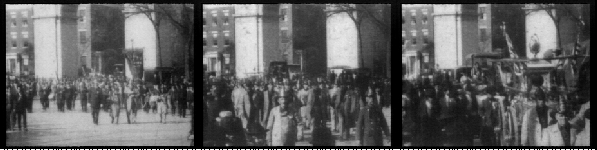
Parade of "exempt" firemen CREATED/PUBLISHED United States : American Mutoscope and Biograph Company, 1903. SUMMARY The film shows a large group of people watching the approach of a color guard followed by a number of elderly marching firemen [Frame: 1734] pulling antique fire equipment [2486]. In the background is the white marble Washington Arch [0116], designed by Stanford White and completed in 1895 to commemorate the first inauguration of George Washington. |
|
Parade of horses on Speedway CREATED/PUBLISHED United States : American Mutoscope and Biograph Company, 1903. SUMMARY The film is of a parade of fine horses and fashionable carriages taken along what is now the Harlem River Drive, in the Highbridge section of northern Manhattan. The view is from the Manhattan side of the river looking north. On the right is the Harlem River and on the opposite bank, the Bronx. Prominent in the background is the High Bridge at 175th Street, an important landmark completed in 1842 as part of the Croton aqueduct system. Beyond the High Bridge is the Washington Bridge at 181st Street. The "Speedway" was built in 1900 at a cost of over three million dollars. |
|
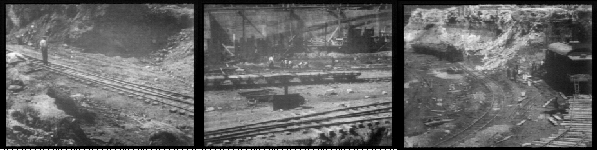
Pennsylvania Tunnel excavation CREATED/PUBLISHED United States : American Mutoscope and Biograph Company, 1905. SUMMARY This film employs a 180-degree pan shot of the excavation site of New York's Pennsylvania Station, and includes shots of the narrow-gauge train used to haul debris from the tunnels under construction. Work began in 1904, and when completed in September of 1910 the station would span from 31st to 33rd Streets, and from 7th to 8th Avenue, an area of approximately 300,000 square feet. It would connect a massive rail tunnel system, bringing the Pennsylvania and Lehigh Railroads under the Hudson River and the Long Island Railroad under the East River to a terminal in the center of Manhattan, accommodating a network of twenty-seven tracks. |
|
A perilous proceeding CREATED/PUBLISHED United States : American Mutoscope and Biograph Company, 1902. SUMMARY The film follows a group of approximately ten men who are suspended on the cable of a large crane atop a building under construction. As the men are lifted over the site and gradually lowered, they wave to the camera. |
|
Pilot boats in New York harbor CREATED/PUBLISHED United States : Thomas A. Edison, Inc., 1899. SUMMARY A New York harbor pilot boat passes close enough for four members of the crew to be seen [Frame: 0471]. Following the sailing vessel is a steamship [0780]. |
|
Skating on lake, Central Park CREATED/PUBLISHED United States : American Mutoscope and Biograph Company, 1902. SUMMARY The view is of a frozen lake in Central Park crowded with ice skaters. |
|
The skyscrapers of New York (in three parts) CREATED/PUBLISHED United States : American Mutoscope and Biograph Company, 1906. SUMMARY This melodrama was filmed during the actual construction of a skyscraper in New York City, and includes several scenes of real work crews: a line of bricklayers [Frame: 1773 (part 1)], a man heating rivets in a forge [2459 (part 1)], riveters assembling steel girders [2859 (part 1)], men astride the steel framework maneuvering and setting a girder in place [3930 (part 1)], and a group of men descending on a crane line [5912 (part 1)]. The story involves a construction foreman who fires one of his crew for fighting, which leads the disgruntled employee to steal. He causes the blame to be put on the foreman, who is finally exonerated when the thief is exposed. All of this conflict is woven in and around the actual construction of the building as the work is in progress. There is even one scene of a hand-to-hand fight between the foreman and the villain that takes place on the unprotected ledge of the steel framework of the building. Some New York City landmarks seen in the film include Union Square (between Broadway and 4th Avenue, 14th-17th Street), and the Everett House, opposite the northeast corner of the square at 17th St. and 4th Avenue [1056 (part 1)]. The film includes the original AM&B title frames at head of film [0105-0272]. |
|
Skyscrapers of New York City, from the North River CREATED/PUBLISHED United States : Thomas A. Edison, Inc., 1903. SUMMARY Filmed from a moving boat, the film depicts the Hudson River (i.e., North River) shoreline and the piers of lower Manhattan beginning around Fulton Street and extending to Castle Garden and Battery Park. It begins at one of the American Line piers (Pier 14 or 15, opposite Fulton Street) where an American Line steamer, either the "New York" or "Paris," is seen docked [Frame: 0120]. The camera passes one of the Manhattan-to-New Jersey commuter ferries to Jersey City or Communipaw [0860]. Proceeding south, the distinct double towers of the Park Row, or Syndicate Building, erected in 1897-98, can be seen in the background [0866]. A coastal freighter is next [1560], then Trinity Church appears, to the left of which can be seen the Surety Building, as a tug with a "C" on the stack passes in foreground [2032]. Several small steamboats come into view [2136], and the B.T. Babbitt Soap factory at Pier 6 is seen [2300], followed by the Pennsylvania Railroad piers (#5 & #4), with a group of docked railroad car floats [2556], and the Lehigh Valley Railroad piers (#3 & #2), also with car floats [3030]. Next are the Bowling Green Building (rectangular, with facade to camera) [3208], the Whitehall Building (vertical, thin side to camera) [3388], followed by Pennsylvania Railroad Pier #1 [3630]. Pier A (with a clock tower) is seen with the New York Harbor Police steam boat "Patrol" at its end [4654]. The Bowling Green Offices and the Produce Exchange at Bowling Green are visible in the background. The breakwater (sheltered landing) and the New York City Fireboat House appears [5270] and the distinctive round structure, Castle Garden, once a fort and immigrant station, but at the time of filming the City Aquarium, comes into view [5438]. The camera then pans east along the Battery Park promenade: the Barge Office (with tower) is visible in the distance [5804], and further out the Brooklyn shoreline with the grain elevators at Atlantic Avenue can be seen [6088]. This view is continued, with only a minor break in continuity, in the film Panorama of Sky Scrapers and Brooklyn Bridge From the East River. Together they comprise a sweep around the southern tip of Manhattan, from Fulton Street on the Hudson to the Brooklyn Bridge. |
|
Sleighing scene CREATED/PUBLISHED United States : Thomas A. Edison, Inc., 1898. SUMMARY A view of a snow-covered road in Central Park. A variety of horse-drawn sleighs ride by the camera from both directions. Only two pedestrians appear. |
|
Sorting refuse at incinerating plant, New York City CREATED/PUBLISHED United States : Thomas A. Edison, Inc., 1903. SUMMARY The subject is a group of about thirty men and boys who are sorting combustible refuse, mostly paper, and stuffing it into large sacks. In the background a man in a hat with an emblem on it can be seen unloading trash from a large wagon. Location may be the New York City Sanitation Department's East 17th Street facility, or possibly the incinerator at West 47th Street on the Hudson River. |
|
Star Theatre CREATED/PUBLISHED United States : American Mutoscope and Biograph Company, 1902. SUMMARY Using time-lapse photography, the film shows the demolition of the famous Star Theatre. Judging from the various exposures, the work must have gone on for a period of approximately thirty days. The theater opened in 1861 as "Wallack's Theatre," and was re-christened the "Star" in 1883. It was well known for it's excellent productions, and a number of celebrated actors and actresses worked there, among them Ellen Terry. The celebrated English actor Henry Irving made his first stage appearance in America at the Star. |
|
Statue of Liberty CREATED/PUBLISHED United States : Thomas A. Edison, Inc., 1898. SUMMARY A three-quarter front view of the Statue of Liberty. The statue was erected twelve years earlier, in 1886. |
|
A street Arab CREATED/PUBLISHED United States : Thomas A. Edison, Inc., 1898. SUMMARY A preadolescent boy, dressed like a street urchin, performs acrobatic stunts for the camera. |
|
What happened on Twenty-third Street, New York City CREATED/PUBLISHED United States : Thomas A. Edison, Inc., 1901. SUMMARY A street level view from the sidewalk, looking along the length of 23rd Street. Following actuality footage of pedestrians and street traffic, the actors, a man in summer attire and a woman in an ankle-length dress, walk toward the camera. As they cross a grate on the sidewalk they pause, and the escaping air blows the woman's dress to her knees. |
|
White Wings on review CREATED/PUBLISHED United States : Thomas A. Edison, Inc., 1903. SUMMARY Filmed on an unidentified street in New York City, probably Fifth Avenue. Rows of men wearing the white uniforms of New York City street sweepers (known as White Wings) march by the camera. Each row has a police escort. The parade of uniformed men continues until several hundred pass. Immediately following the marching men come approximately a hundred horse-drawn two-wheel carts of the kind used for hauling garbage [Frame: 3394]. One four wheeled cart is seen near the end of the film. In 1895, under the reform administration of Mayor William L. Strong, New York City's Department of Street Cleaning was headed by Colonel George Waring. It was he who garbed his workers in the white duck suits (earning them the name "White Wings") seen in the film. He is also recognized as a brilliant sanitary engineer who marshalled the two thousand man force to clean four hundred and fifty miles of streets each day. According to Jacob Riis, "his broom saved more lives in the crowded tenements than a squad of doctors." By 1903, the date of the filming, a new city administration was in power and Waring had been replaced. |
Here are the computer requirements to run and operate this CD. You must have a PC running Windows or a Macintosh running OS X or higher software and a web browser.