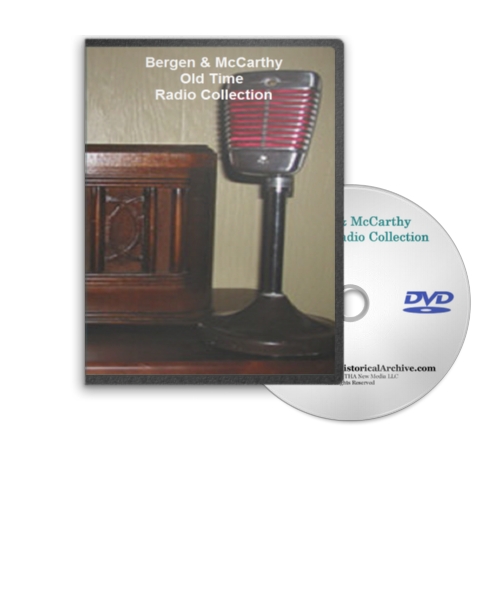
This collection of Bergen & McCarthy Greats includes 64 different shows and appearances for a total of 32+ hours of listening enjoyment.
Bergen was born Edgar John Bergren in Chicago, Illinois to a Swedish family and grew up in Decatur, Michigan. He taught himself ventriloquism from a pamphlet when he was 11. A few years later he commissioned Chicago woodcarver Theodore Mack to sculpt a likeness of a rascally Irish newspaper boy he knew. The head went on a puppet named Charlie McCarthy, who became Bergen's lifelong sidekick. At age 16, he came to Chicago, where he attended Lake View High School and worked at a silent movie house.
His first performances were in vaudeville and one-reel movie shorts, but his real success was on the radio. He and Charlie were seen at a New York party by Elsa Maxwell for Noel Coward, who recommended them for an engagement at the famous Rainbow Room. It was there that two producers saw Bergen and Charlie perform. They then recommended them for a guest appearance on Rudy Vallee's program. The appearance was so successful that the next year they were given their own show. Under various sponsors, they were on the air from December 17, 1937 to July 1, 1956. The popularity of a ventriloquist on radio, when one could see neither the dummies nor his skill, surprised and puzzled many critics, then and now. However, it was Bergen's skill as an entertainer and vocal performer, and especially his characterization of Charlie, that carried the show over.
For the radio program, Bergen developed other characters, notably the slow-witted Mortimer Snerd and the man-hungry Effie Klinker. The star, however, was Charlie, who was always presented as a child (albeit in top hat, cape, and monocle) a debonair, girl-crazy, child-about-town. As a child, and a wooden one at that, Charlie could get away with double entendre that adult humans could not under broadcast standards of the day.
Bergen was not the most technically skilled ventriloquist. Charlie McCarthy frequently twitted him for moving his lips but Bergen's sense of comedic timing was superb, and he handled Charlie's snappy dialogue with aplomb. Bergen's wit in creating McCarthy's striking personality and that of his other characters was the making of the show. The fact that Bergen was widely popular for a ventriloquism act on radio (where the trick of "throwing his voice" was not visible) indicates that his appeal was primarily the personality he applied to his characters.
Bergen and McCarthy are sometimes credited with "saving the world" because, on the night of October 30, 1938 when Orson Welles performed his War of the Worlds radio play that panicked many listeners, most of the American public had instead tuned in to Bergen and McCarthy on another station and never heard Welles' play. Conversely, it has also been theorized that Bergen inadvertently contributed to the hysteria. When the musical portion of Bergen's show, The Chase and Sanborn Hour, aired approximately 12 minutes into the show, many listeners switched stations and found the War of the Worlds presentation already underway, with a realistic sounding reporter detailing terrible events.
This collection of Bergen & McCarthy Greats includes 64 different shows and appearances for a total of 32+ hours of listening enjoyment.

This product is a DVD collection of Old Time Radio mp3s. It is designed to be played on your computer DVD drive with standard mp3 software - like Windows media player or its equivalent on Macintosh computers. The mp3 files on the DVDs can be copied onto CDs for play in your car stereo, home entertainment center, etc so you can take your favorite shows with you anywhere you go.