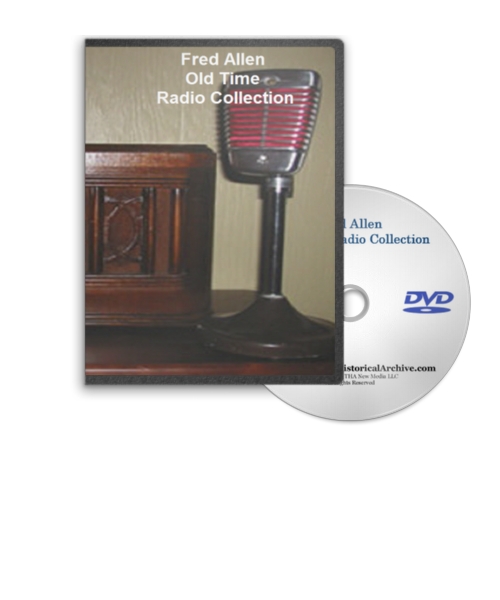
This collection of Fred Allen Greats includes 79 different shows and appearances for a total of 34 hours of listening enjoyment.
Fred Allen's Town Hall Tonight was the longest-running hour-long comedy-based show in classic radio history. In 1940, Allen moved back to CBS with a new sponsor and show name, Texaco Star Theater. By 1942, he shortened the show to half an hour under network and sponsor edict, not his own. He also chafed under being forced to give up a Town Hall Tonight signature, using barely-known and amateur guests effectively, in favor of booking more recognizable guests, though he liked many of those.
He took over a year off due to hypertension and returned in 1944 with The Fred Allen Show on NBC. Blue Bonnet Margarine, Tenderleaf Tea and Ford Motor Company were the sponsors for the rest of the show's life. Texaco revived Texaco Star Theater in 1948 on radio, and more successfully on television, making an American icon out of star Milton Berle).
Allen again made a few changes. One was adding the singing DeMarco Sisters, to whom he'd been tipped by arranger-composer Gordon Jenkins. "We did four years with Mr. Allen and got one thousand dollars a week," Gloria DeMarco remembered. "Sunday night was the best night on radio." Sunday night with Fred Allen seemed incomplete on any night listeners didn't hear the DeMarco Sisters whose breezy, harmonious style became as familiar as their cheerfully sung "Mr. Al-len, Mr. Alll-llennnn" in the show's opening theme. During the theme's brief pause, Allen would say something like, "It isn't the mayor of Anaheim, Azusa and Cucamonga, kiddies." That device became a signature for three of the four years.
The other change, born in the Texaco days and evolved from his earlier news spoofs, proved his most enduring, premiering December 13, 1942. "Allen's Alley" followed a brief Allen monologue and comic segment with Portland Hoffa ("Misssss-ter Allll-llennnn!"), usually involving gags about her family which she instigated. Then, a brief music interlude would symbolize the two making their way to the fictitious alley, always launched by a quick exchange that began with Hoffa asking Allen what he would ask the Alley denizens that week. After she implored him "Shall we go?", Allen would reply with cracks like "As the two drumsticks said when they spotted the tympani, 'let's beat it!'"; or, "As one strapless gown said to the other strapless gown, 'What's holding us up?'"
A small host of stereotypical characters greeted Allen and Hoffa down the Alley, discussing Allen's question of the week, usually drawing on news items or popular happenings around town, whether gas rationing, traffic congestion, the Pulitzer Prizes, postwar holiday travel, or the annual Ringling Brothers and Barnum & Bailey Circus visit.
The Alley went through a few changes in the first installments. Early denizens included sarcastic John Doe (John Brown), self-possessed Senator Bloat (Jack Smart), dimwit Socrates Mulligan (Charlie Cantor), and pompous poet Falstaff Openshaw (Alan Reed). But soon the Alley's four best-remembered regulars moved in and rarely disappeared: announcer Kenny Delmar as bellowing ("Some Ah say, somebody's knockin' at mah doah!") Senator Beauregard Claghorn (the model for cartoon character Foghorn Leghorn), Parker Fennelly as stoic New England farmer, Titus Moody, Minerva Pious as the Jewish housewife, Pansy Nussbaum, and Peter Donald as fast-talking Irishman, Ajax Cassidy.
This collection of Fred Allen Greats includes 79 different shows and appearances for a total of 34 hours of listening enjoyment.

This product is a DVD collection of Old Time Radio mp3s. It is designed to be played on your computer DVD drive with standard mp3 software - like Windows media player or its equivalent on Macintosh computers. The mp3 files on the DVDs can be copied onto CDs for play in your car stereo, home entertainment center, etc so you can take your favorite shows with you anywhere you go.